

After completing Wudu, Muslims are encouraged to remember Allah and recite a short supplication. The Wazu Ke Baad Ki Dua in English is easy to learn and carries a beautiful meaning about faith, repentance, and purification.
If you are trying to memorize the dua after Wudu, below you will find the Arabic text, English transliteration, translation, hadith reference, and a simple explanation of its importance.
Wazu Ke Baad Ki Dua in Arabic
After finishing Wudu, recite:
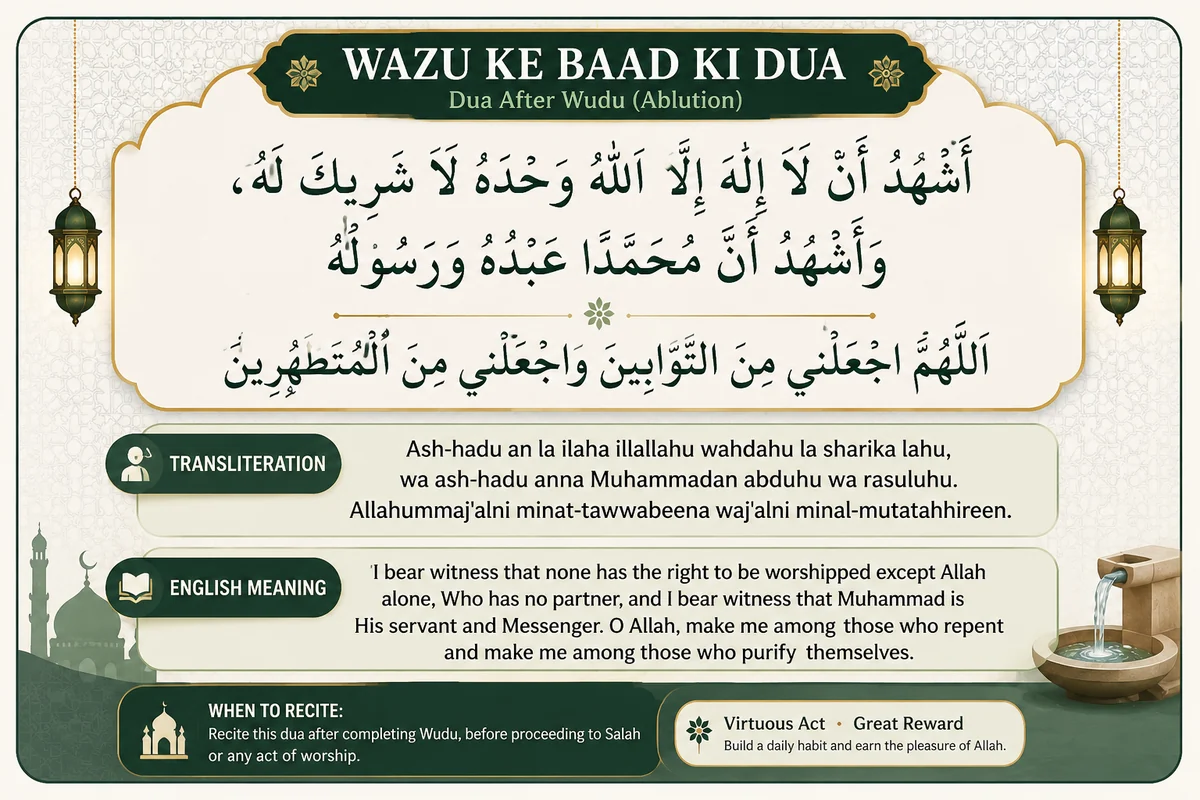
أَشْهَدُ أَنْ لَا إِلٰهَ إِلَّا اللّٰهُ وَحْدَهُ لَا شَرِيكَ لَهُ، وَأَشْهَدُ أَنَّ مُحَمَّدًا عَبْدُهُ وَرَسُولُهُ
اللَّهُمَّ اجْعَلْنِي مِنَ التَّوَّابِينَ وَاجْعَلْنِي مِنَ الْمُتَطَهِّرِينَ
This combines the declaration of faith with a prayer asking Allah to make us among those who repent and keep themselves purified.
Wazu Ke Baad Ki Dua in English Transliteration
Ash-hadu an la ilaha illallahu wahdahu la sharika lahu, wa ash-hadu anna Muhammadan abduhu wa rasuluhu.
Allahummaj'alni minat-tawwabeena waj'alni minal-mutatahhireen.
If you cannot read Arabic yet, the transliteration is a helpful way to memorize the words and gradually improve your pronunciation.
Wazu Ke Baad Ki Dua English Translation
The English meaning is:
“I bear witness that none has the right to be worshipped except Allah alone, Who has no partner, and I bear witness that Muhammad is His servant and Messenger. O Allah, make me among those who repent and make me among those who purify themselves.”
The meaning fits perfectly with Wudu. We physically clean ourselves with water, then ask Allah for spiritual purification as well.
When Should You Read the Dua After Wudu?
The dua is recited after you have completed Wudu.
Finish all the required steps of ablution first. Once your Wudu is complete, recite the Shahada and, if you wish, the additional supplication asking Allah for repentance and purification.
You do not have to read a separate dua for every body part while making Wudu. The well-known remembrance discussed here is said after ablution is finished.
If you want to learn the correct steps of ablution, you can also read this guide on how to perform Wudu.
Hadith About the Dua After Wudu
The virtue of remembering Allah after Wudu is mentioned in authentic hadith.
Umar ibn al-Khattab (RA) reported that Prophet Muhammad ﷺ said that whoever performs Wudu properly and then testifies that none has the right to be worshipped except Allah alone, and that Muhammad ﷺ is His servant and Messenger, will have the eight gates of Paradise opened for him so that he may enter through whichever he wishes.
You can read the narration in Sahih Muslim.
This shows that a small act of remembrance after Wudu can carry a great reward.
Meaning and Importance of the Dua After Wudu
The dua teaches several important lessons.
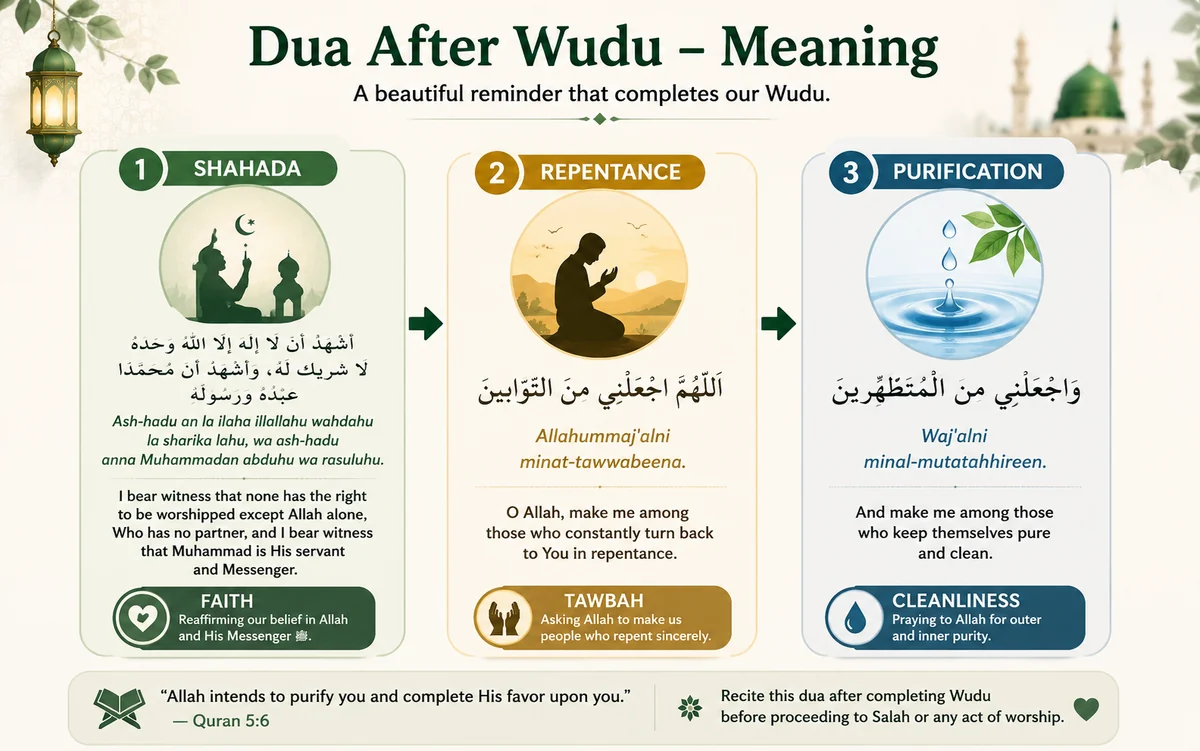
Declaring the Oneness of Allah
The words “La ilaha illallah” reaffirm Tawheed—the belief that Allah alone deserves worship.
It is a reminder that purification is not only about washing the body. Wudu also prepares the heart and mind for Salah and the remembrance of Allah.
Following Prophet Muhammad ﷺ
The words declaring Muhammad ﷺ as Allah's servant and Messenger remind Muslims to follow the guidance and Sunnah of the Prophet ﷺ in worship and everyday life.
Asking for Repentance
“Allahummaj'alni minat-tawwabeena” means:
“O Allah, make me among those who repent.”
Every person makes mistakes. This dua reminds us to regularly return to Allah and ask for forgiveness.
Asking for Purification
“Waj'alni minal-mutatahhireen” means:
“And make me among those who purify themselves.”
This connects physical cleanliness with spiritual cleanliness. In Surah Al-Ma'idah 5:6, Allah explains the rulings of purification and mentions His intention to purify believers and complete His favor upon them.
Is Wazu Ke Baad Ki Dua Compulsory?
No, the dua after Wudu is not compulsory for the validity of Wudu.
If you forget to recite it, your Wudu is still valid as long as you completed the required acts of ablution correctly.
However, reciting the remembrance after Wudu is recommended and carries significant reward. Because the words are short, it is worth memorizing them and making them part of your daily routine.
Dua Before Wudu and Dua After Wudu
People sometimes confuse the two.
Before beginning Wudu, say:
بِسْمِ اللهِ
Bismillah
Meaning:
“In the name of Allah.”
After finishing Wudu, recite the Shahada:
Ash-hadu an la ilaha illallahu wahdahu la sharika lahu, wa ash-hadu anna Muhammadan abduhu wa rasuluhu.
You may then add:
Allahummaj'alni minat-tawwabeena waj'alni minal-mutatahhireen.
Another Supplication After Wudu
Another remembrance commonly mentioned after Wudu is:
Subhanaka Allahumma wa bihamdika, ash-hadu an la ilaha illa anta, astaghfiruka wa atubu ilayk.
Meaning:
“Glory and praise are Yours, O Allah. I bear witness that there is none worthy of worship except You. I seek Your forgiveness and repent to You.”
For more daily supplications and references, you can explore Hisnul Muslim.
Frequently Asked Questions
What is the dua after Wudu in English?
It is a declaration that Allah alone deserves worship and that Muhammad ﷺ is His servant and Messenger, followed by a prayer asking Allah to make us among those who repent and remain purified.
What should I say immediately after Wudu?
Recite the Shahada after completing Wudu. You can also add “Allahummaj'alni minat-tawwabeena waj'alni minal-mutatahhireen.”
Is the dua after Wudu mandatory?
No. Forgetting it does not invalidate your Wudu.
What is the reward for reciting the dua after Wudu?
Authentic hadith mentions that the eight gates of Paradise are opened for the person who completes Wudu properly and recites the prescribed testimony of faith afterward.
Can I read only the Shahada after Wudu?
Yes. The Shahada is authentically established as a remembrance after Wudu.
Final Thoughts
The Wazu Ke Baad Ki Dua in English is short, meaningful, and easy to add to your daily routine. It reminds us that Wudu is not only about cleaning the body—it is also an opportunity to renew our faith, seek forgiveness, and ask Allah for inner purification.
Memorize the Arabic gradually, understand its meaning, and try to recite it whenever you complete Wudu.

 Sone Ki Dua
  Subah Uthne Ki Dua